If your shoes live in a pile on the closet floor, you’re not alone.
You know the morning scramble: one sandal under the dresses, the other somewhere behind your boots. Learning how to organize shoes in a small closet can feel impossible at first. But once you spot the wasted space hiding on your shelves, door, and floor, it gets much easier.
The good news? You don’t need a bigger closet or a big budget. You just need a tape measure, a simple plan, and a few smart space-saving shoe storage tricks.
Table of Contents
How to Organize Shoes in a Small Closet: The 3-Step Method
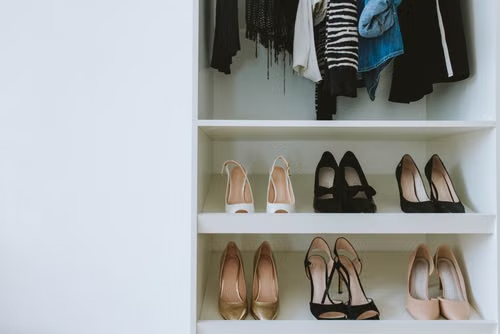
Step 1: Declutter Your Shoe Collection (Keep, Donate, Store)
Before you buy a single shoe organizer, find out what you actually own. Professional organizers typically start with decluttering, and the expert-sourced guide at Homes & Gardens does too.
Pull every pair out of your closet and lay them out in one place. Yes, even the ones hiding in the back.
Now sort them into three piles:
- Keep: shoes you wear and love
- Donate or sell: pairs that don’t fit, hurt your feet, or you haven’t worn in a year
- Store elsewhere: off-season or special-occasion shoes
For example, if you find four pairs of black flats and you only wear one, let the other three go. Duplicates are the fastest way to free up closet space.
Not sure about a pair? Try the one-year rule: if you haven’t worn them in a year (and they’re not a special-occasion pair), they’re ready for a new home.
Step 2: Measure Your Closet Shelves, Rod, and Door Space
This is the step most people skip, and it’s the one that saves the most money (and returns).
Grab a tape measure and write down:
- Shelf height (the gap between shelves)
- Shelf depth (front to back)
- Floor space (width and depth)
- Hanging rod space (how much room is left after your clothes)
- Door clearance (will the door still close with something hanging on it?)
Then hold your biggest pair of shoes against the shelf depth. For example, if your shelf is 11 inches deep and your sneakers are 12 inches long, they’ll stick out and your closet doors may not shut. Place them sideways or choose a different spot.
Here’s a quick guide to shelf height:
| Shelf Gap | What Fits Best |
|---|---|
| About 5–6 inches | Sneakers, sandals, flats |
| About 8+ inches | Heels, loafers, ankle boots |
| Tall open space | Tall boots (or use hanging storage) |
Swipe left or right to view all columns →
Step 3: Choose a Shoe Sorting System You'll Actually Stick To
A good shoe organization system makes shoes easy to find and easy to put back.
Pick the one that fits your life:
- By how often you wear them: everyday shoes at eye level, occasional pairs higher or lower
- By type: sneakers together, heels together, boots together
- By season: summer sandals in front now, winter boots in the back (swap later)
- By color: pretty to look at, and handy if you own lots of similar pairs
Think of your closet in three zones: eye level for daily shoes, lower shelves for heavier or seasonal pairs, and top shelves for rarely worn shoes.
Our suggestion for beginners: sort by how often you wear them. It works in almost every small closet.
Sharing your closet? Give each person their own zone. Labeled bins or color-coded baskets make this easy and help avoid arguments.
9 Space-Saving Ideas to Organize Shoes in a Small Closet
Here are the best small closet shoe storage ideas, from free hacks to affordable shoe rack upgrades. Each idea shows who it suits, roughly how many pairs it holds, how to set it up, and what it costs.
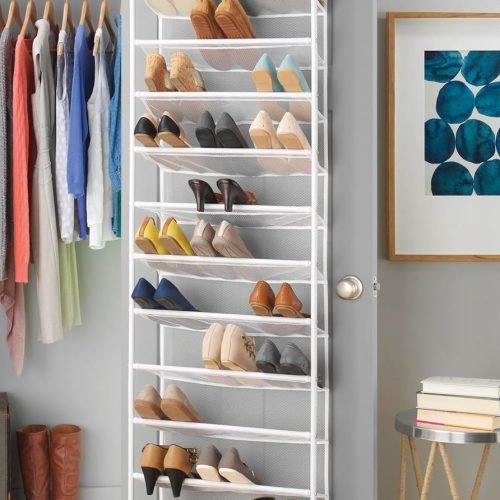
1. Over-the-Door Shoe Organizer: Turn Your Closet Door Into Storage
What it is: A hanging shoe organizer with pockets or shelves that hooks over the top of your closet door.
Best for: Flats, sneakers, sandals, and slippers.
Capacity: Roughly 12 to 36 pairs, depending on the size and style.
Why it works: The back of a closet door is free vertical space that most people never use. Moving your daily flats and sneakers there clears your shelves and floor for bulkier pairs.
How to set it up:
- Hang it over the top of the door.
- Check that the door still closes smoothly.
- Put your everyday pairs in the pockets at eye level.
Pro tip: Clear pockets help you spot a pair at a glance. Fabric pockets are lightweight, so skip heavy boots here, and choose sturdier styles if you plan to fill every pocket.
Budget: Usually $15–$35 · No drilling needed
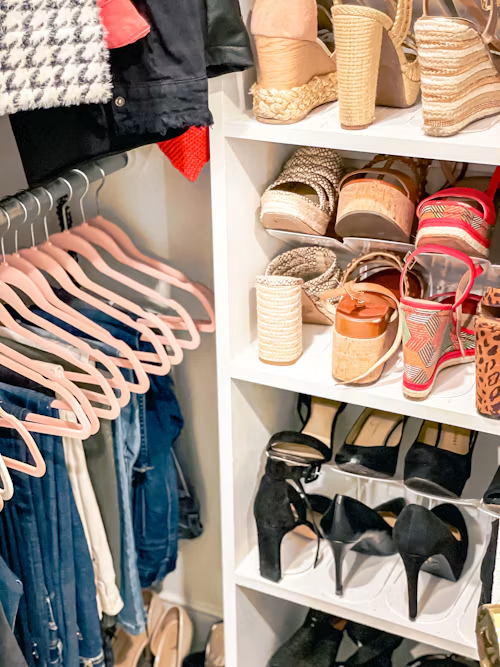
2. Shoe Risers and Shoe Slots: Double Your Shelf Space
What it is: Small stackable platforms (also sold as shoe slots) that let you place one pair above another on the same shelf.
Best for: Flats, sneakers, and sandals on shelves with extra empty space above them.
Capacity: Can roughly double what a shelf holds.
Why it works: Many closet shelves are taller than the shoes sitting on them, so the air above your shoes is wasted space. Risers let you stack pairs instead of lining them up side by side.
How to set it up:
- Measure the gap above your shoes.
- Choose adjustable risers that fit that height.
- Place one pair on the riser and another pair beneath it.
Budget: Usually under $20 · No drilling needed
3. Heel-to-Toe Arrangement: A Free Way to Fit More Pairs on a Shelf
What it is: Alternating the direction of each pair so one shoe’s heel sits next to the next shoe’s toe.
Best for: Anyone who needs a few extra inches right now, for free.
Why it works: Shoes are narrower at the heel and wider at the toe. Flipping every other pair removes the small gaps between them.
It may sound minor. But across several shelves, it can free up room for an extra pair or two.
Budget: Free · No drilling needed
4. Clear Stackable Shoe Boxes: Dust-Free Storage You Can See Through
What it is: Transparent boxes with lids that stack neatly.
Best for: Special-occasion shoes, off-season pairs, and shoes you want to keep dust-free.
Why it works: Original cardboard boxes are bulky and you can’t see inside. Clear boxes are uniform, stack well, and let you spot the right pair in seconds.
How to set it up:
- Toss the original shoe boxes.
- Place each pair in a clear box.
- Stick a photo of the shoes on the front for quick finding.
Pro tip: Boxes take extra effort to reach, so keep your daily shoes out of them.
Budget: Usually $20+ for a set · No drilling needed
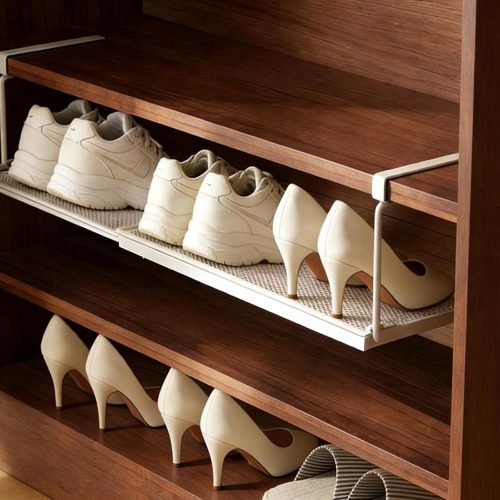
5. Under-Shelf Shoe Racks and Baskets: Use the Empty Space Below Shelves
What it is: A rack or basket that slides or clips onto the underside of a shelf, using the empty space beneath it.
Best for: Flats, sandals, and lightweight shoes.
Good to know: Many expandable versions stretch from about 15 to 28 inches, so they fit a range of shelf sizes. Check the weight limit, and put lighter pairs on the rack and heavier pairs on the shelf.
Budget: Usually $15–$30 · No drilling needed
6. Tension Rod Shoe Shelf: A No-Drill DIY Shoe Rack
What it is: Two tension rods placed side by side, with the back one slightly higher. Shoes rest on top, tilted so you can see them.
Best for: Tiny closets with no shelves or with awkward gaps.
Why people love it: It’s cheap, damage-free, and easy to adjust. If you move, take it down in minutes.
How to set it up:
- Measure the width of your closet space.
- Install two rods at the same height, then raise the back rod a little.
- Rest your shoes on top with the heels toward the back.
Pro tip: Use rods rated for the weight you plan to load, and keep this setup for lightweight pairs like flats and sandals.
Budget: Free to under $15 · No drilling needed
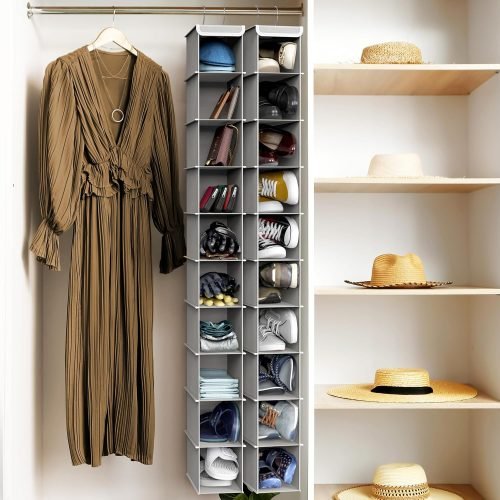
7. Hanging Shoe Shelves: Vertical Storage on Your Closet Rod
What it is: Fabric or mesh hanging shelves that hook onto your clothing rod like a ladder.
Best for: Closets with rod space but little shelf space.
Capacity: Smaller versions hold about 8 pairs, while larger ones can hold around 20 to 24.
Pro tip: Choose a style with sturdy hooks. Weak attachments may not support a full load of shoes.
Budget: Usually $15–$30 · No drilling needed
8. Underbed Shoe Storage: Where to Keep Off-Season Shoes
What it is: Low bins, crates, or underbed boxes that keep seasonal shoes out of your closet.
Best for: Winter boots in summer, sandals in winter, and shoes you rarely wear.
Why it works: Your small closet only holds what you use now. Everything else lives elsewhere until the season changes.
Pro tip: Foldable crates are great because they fold flat when empty.
Budget: Usually $20–$30 · No drilling needed
9. Narrow and Tiered Shoe Racks: Fit Shoes in Tight Corners and High Shelves
What it is: A slim shoe rack about one pair wide, or a small tiered shoe rack (2–3 tiers) for a floor corner or a high shelf.
Best for: Tight corners, empty floor gaps, and unused space near the ceiling.
Good to know: Narrow racks are short, so they usually add room for a few extra pairs, around 5.
Safety tip: Keep top-shelf racks to 2–3 tiers so they don’t tip over. If you can, attach tall racks to the shelf or wall.
Budget: Usually $20+ · No drilling needed (drilling is optional if you anchor a tall rack)
Shoe Storage Ideas Compared: Which Is Best for Your Small Closet?
Not sure where to start? This table compares all 9 shoe storage ideas side by side.
| Idea | Pairs It Adds (Approx.) | Typical Cost | Drilling Needed? | Best For |
|---|---|---|---|---|
| Over-the-door shoe organizer | 12–36 | Low to medium | No | Flats, sneakers, sandals |
| Shoe risers | Roughly doubles a shelf | Low | No | Shelves with extra height |
| Heel-to-toe arrangement | +1 to +2 | Free | No | A quick fix |
| Clear stackable boxes | Varies | Medium | No | Dust protection, special shoes |
| Under-shelf rack | 2–6 | Low to medium | No | Lightweight shoes |
| Tension rod shelf | 2–6 | Free to low | No | Closets with no shelves |
| Hanging shoe shelves | 8–24 | Low to medium | No | Closets with spare rod space |
| Underbed bins or crates | Varies | Low to medium | No | Off-season shoes |
| Narrow or tiered shoe rack | About 5 | Medium | Optional (anchor tall racks) | Tight corners, high shelves |
Swipe left or right to view all columns →
Low means under about 20 dollars, and medium means about 20 to 40 dollars. Capacities and prices vary by product, so check the details before you buy.
Quick picks:
- Tight budget? Start with the heel-to-toe arrangement, a tension rod shelf, or risers.
- No shelves at all? Try a tension rod shelf, hanging shoe shelves, or an over-the-door organizer.
- Lots of sneakers and flats? An over-the-door organizer plus risers is hard to beat.
- Off-season shoes crowding the closet? Move them under the bed.
Best Shoe Storage Setup for Reach-In, Shared, and Tiny Closets
Not every closet is the same. Here’s how to match your closet layout to the right ideas.
Shoe Storage for a Reach-In Closet
A reach-in closet usually has a rod and one or two shelves. Combine an over-the-door organizer with risers on the shelf, and keep a small basket or stackable shoe rack on the floor for your daily pairs.
Picture a 4-foot reach-in closet with one shelf and about 20 pairs. Flats and sandals go in the door organizer, sneakers sit on risers, and boots stand on the floor. Nothing is piled up, and every pair is easy to reach.
How to Organize Shoes in a Shared Closet
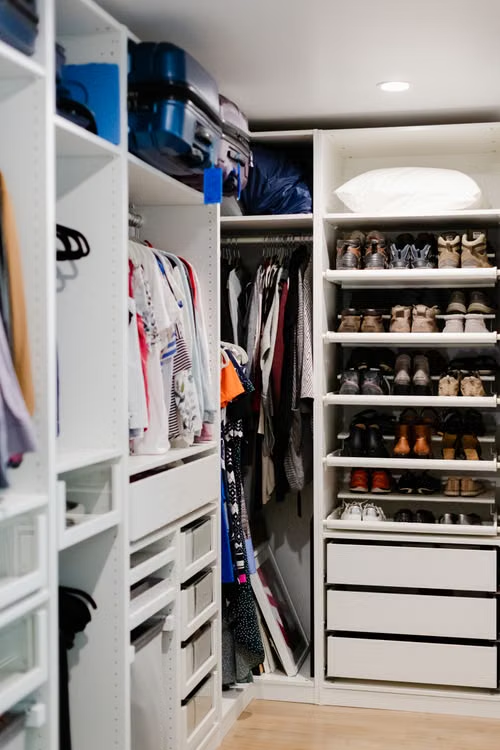
If two people use one closet, divide the space into clear zones. Use labeled bins or color-coded baskets. Each person keeps their everyday pairs at eye level in their own zone, and you can split the over-the-door organizer by rows.
Shoe Storage for a Tiny Closet or Wardrobe With No Shelves
This is where tension rods, hanging shelves, and underbed storage shine. Keep only your current-season shoes inside and move the rest out.
How to Store Sneakers, Heels, Boots, and Sandals in a Small Closet
Different shoes need different care. Here’s a simple guide.
- Sneakers: Store them in shoe cubbies, on short shelves, in clear boxes, or in crates. They’re sturdy, so they handle stacking well.
- Heels: Use risers or dividers so the heels don’t get squashed. Heel-to-toe works well too.
- Boots: Tall boots flop over, which wastes space and can crease them. Use a boot organizer, boot shapers, or hanging boot clips (choose gentle ones that won’t leave marks).
- Flats and sandals: Great for over-the-door pockets, under-shelf baskets, and upright bins. Closet shelf dividers also keep stacks of flats from toppling.
Common Small Closet Shoe Storage Mistakes to Avoid
These small errors can make a small closet feel even smaller.
- Buying before measuring. Always measure first, then shop.
- Overloading racks and organizers. Check weight limits, especially on over-the-door and hanging styles.
- Stacking heavy shoes on flimsy racks. Put heavier pairs on sturdy shelves.
- Using only opaque boxes. If you can’t see it, you won’t wear it.
- Forgetting airflow. Leave about 1–2 inches between shelves when you can, and consider cedar blocks or activated charcoal sachets to help with odor.
- Keeping shoes you never wear. Every unworn pair takes space from the ones you actually use.
How to Keep Your Closet Shoe Storage Organized Long Term
Organizing once is easy. Staying organized is the real win. Try these habits:
- One in, one out: When you buy a new pair, let an old pair go.
- Seasonal swap: Twice a year, move off-season shoes out and bring current ones in.
- 5-minute weekly reset: Put stray pairs back where they belong.
- Clean before storing: Wipe off dirt and let shoes dry fully before they go in a box or bin.
Frequently Asked Questions About Organizing Shoes in a Small Closet
How do you organize shoes in a small closet?
Start by decluttering and measuring your space. Then use vertical storage: an over-the-door shoe organizer, shoe risers, and hanging shelves. Keep your everyday shoes easy to reach and store off-season pairs elsewhere, like under the bed.
How do I organize shoes in a closet with no shelves?
Try a tension rod shoe shelf, hanging shoe shelves on the rod, or an over-the-door organizer. All three need no drilling. Add a small stackable shoe rack on the floor for daily pairs.
How do you organize too many shoes?
Begin with a declutter. Donate or sell pairs you don’t wear. Then store seasonal shoes outside the closet and use risers or clear boxes to fit the pairs you keep.
How do I organize shoes when sharing a closet?
Divide the closet into personal zones. Use labeled bins, color-coded baskets, or separate shelves so each person knows where their shoes belong.
How do I organize shoes by type or frequency of use?
Put daily shoes at eye level or in front. Group the rest by type (sneakers, heels, boots) using labeled bins, dividers, or separate shelves. Move rarely worn pairs to higher or lower spots.
Final Thoughts: Easy Ways to Organize Shoes in a Small Closet
You don’t need a walk-in closet to have an organized shoe collection.
Start by decluttering. Then measure, choose a sorting system, and pick the storage ideas that fit your closet and budget. Even one or two changes, like adding risers or an over-the-door organizer, can make a big difference.
Pick one idea from this list and try it this weekend. You’ll be surprised how much space you gain.