If your bedroom feels tight, you’re in good company. Plenty of us live with a small bedroom at some point, whether it’s a first apartment, a shared flat or a family home with a tiny box room.
Here’s the good news. A small room often feels cramped because of visual weight, not just square footage. Dark colors, bulky furniture, heavy curtains and clutter all make a space feel crowded. Change those, and the same room can feel more open and airy.
Designers call this the illusion of space. You can’t add square feet, but you can use a few simple optical illusions to make a small room look bigger and feel calmer.
In this guide, you’ll get 12 small bedroom ideas ranked by how much they change the room, what they cost and whether renters can do them.
Table of Contents
The 3 Ideas Behind Every Small Bedroom Makeover
Every tip below follows one of three simple ideas:
- Reflect more light. Light colors, mirrors and sheer curtains help.
- Show more floor. Slim-legged furniture, a clear walkway and fewer items help.
- Draw the eye up. High curtains, tall headboards and vertical lines help.
Keep these in mind, and you can judge any small bedroom decorating idea for yourself.
Quick Wins: Make a Small Bedroom Look Bigger in One Weekend
Short on time? Start here. These five changes give the biggest effect for the least effort.
- Clear the floor and surfaces first. It’s free and makes the biggest difference.
- Use one light, cohesive color on the walls, and ideally the ceiling too.
- Put one large mirror near or opposite a window to bounce natural light around.
- Hang light curtains high so the window feels taller.
- Choose slim-legged or wall-mounted furniture and keep a clear walkway beside the bed.
Want the full list? Keep scrolling. The tips run from biggest change to smallest.

How to Measure a Small Bedroom Before You Buy or Rearrange Anything
Before you move a single piece of furniture, grab a tape measure and a notebook. Good small bedroom layout decisions start with real numbers, not guesses. It only takes about 10 minutes.
Imagine a bedroom that’s roughly 10 feet by 10 feet. If the bed, two nightstands and a dresser are pushed in without a plan, there’s hardly any room to walk. A few measurements can save you from buying furniture that simply doesn’t fit.
| What to Measure | Why It Matters |
|---|---|
| Ceiling height | Tells you whether to choose low or tall furniture |
| Room length and width | Shows how much usable floor space you really have |
| Window width and sill height | Helps you place mirrors and hang curtains |
| Door swing | Keeps the door from hitting furniture |
| Bed size | Shows how much space is left around it |
| Walkway beside the bed | Keeps the room easy to move around in |
Swipe left or right to view all columns →
Beginner tip: Before you buy anything, mark where the new furniture would sit on the floor with painter’s tape. It’s a quick way to test a furniture arrangement without lifting a thing.
Which Small Bedroom Ideas Work Best for Your Room Type?
Every room is different. Find your situation below, and start with the ideas listed for it.
| Your Room | Do This First | Avoid |
|---|---|---|
| Low ceiling | A low bed with visible legs, vertical lines, a light ceiling color | Tall, bulky furniture |
| High ceiling | A taller headboard and taller furniture to keep things in proportion | Making everything small and low |
| Dark room or little natural light | Light colors, layered lighting, a mirror opposite the window | Heavy curtains and a single ceiling light |
| Narrow room | Bed on the long wall, fewer pieces, a clear path | Furniture that blocks the walkway |
| No window | Warm layered lighting and a mirror that reflects a light source | Dark colors with weak lighting |
| Bedroom that is also an office | A fold-away desk, a curtain divider, a light palette | A big desk that dominates the room |
Swipe left or right to view all columns →
12 Small Bedroom Ideas That Create the Illusion of Space (Ranked by Impact and Cost)
These tips are ranked using three simple questions. How big is the visual change? How much does it cost? How often do the leading guides recommend it? Each tip also has a renter-friendly tag, so you can pick what suits you.
1. Declutter and Clear Floor Space to Make a Small Bedroom Feel Bigger
Cost: Free | Renter-friendly: Yes
This is the easiest and most powerful change. Interior designers quoted by Woman & Home usually start with a thorough declutter, because extra “stuff” eats into the little space you have. When you can see more floor space and more empty surface, your brain reads the room as bigger.
Picture a room with a laundry basket by the door, shoes in a pile and three things on every surface. Now picture the same room with only a lamp and a book on the nightstand. Same room, very different feeling.
Try this today:
- Remove anything you don’t use or love.
- Keep a clear walkway beside the bed.
- Leave nightstands and dressers mostly bare.
- Use bedroom storage ideas such as under-bed boxes or wall shelves for what’s left, and keep them neat.
2. Best Paint Colors for a Small Bedroom: One Light Shade on Walls and Ceiling
Cost: Low | Renter-friendly: Partly (ask your landlord before painting)
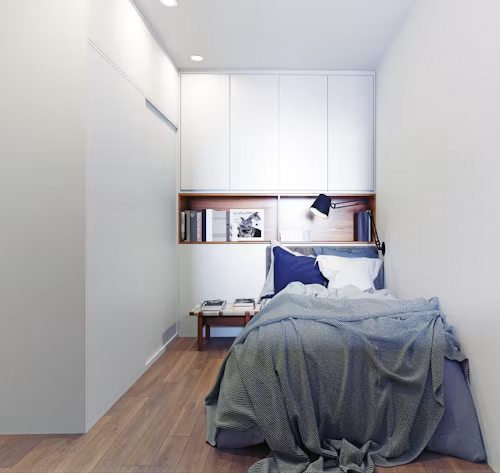
Light colors reflect more natural light, so the room feels brighter and more open. Soft white, warm beige, pale gray, soft green and blush pink are all good paint colors for a small bedroom.
Here’s a designer trick worth knowing. Designers quoted by Apartment Therapy recommend painting the walls and ceiling the same color. It blurs the lines where they meet, so the room reads as one calm space instead of a box with hard edges. This is a classic way to create an optical illusion of height.
Always test a sample on the wall and look at it in the morning and at night. A color palette can look very different as the light changes.
3. Where to Hang a Large Mirror to Reflect Natural Light
Cost: Low to Medium | Renter-friendly: Yes (just lean it against the wall)
Mirrors are a classic way to make a room look bigger because they reflect light and add a sense of depth. They also double as bedroom decor, so you get two jobs from one piece.
The Home Depot’s small bedroom guide suggests placing a mirror close to a window or directly across from it. The mirror catches daylight and bounces it into the room, so everything feels brighter.
Stick to one big mirror rather than many small ones. Too many mirrors can look busy in a small space.

4. Curtain Ideas for Small Bedrooms: Hang Light Panels High and Wide
Cost: Low | Renter-friendly: Yes
Heavy, dark curtains block light and shrink your window. Light, sheer fabrics let daylight in and keep the room airy.
Place the curtain rod higher and wider than the window frame, as West Homes suggests. This makes the window look taller and shows more glass when the curtains are open.
Let the panels reach the floor, or stop about 1 inch above it, a length that RentCafe’s bedroom guide also recommends. Stylists often pick curtains close to the wall color, so the window blends in instead of cutting the wall in two.
Do these four first. Tips 1 to 4 give the biggest change for the least money. If you do nothing else, start here.
5. Choose Space-Saving Bedroom Furniture with Slim Legs
Cost: Medium | Renter-friendly: Yes
When you can see the floor under your bed and nightstands, the room feels lighter. The Home Depot explains it simply: light glowing under furniture makes a space feel larger, and it suggests using at least one piece with exposed legs.
Compare two beds. One is a chunky box frame that sits right on the floor. The other is a slim frame on thin legs. The second one lets light and floor show through, so the room feels less crowded.
Smart swaps to try:
- Use wall-mounted or floating nightstands to free up floor space.
- Pick pieces with exposed legs instead of solid blocks.
- Choose furniture in proportion to your room, not the biggest size that fits.
If you have a low ceiling, a lower bed frame helps the room feel taller.
6. Bedroom Lighting Ideas: Layer Your Light and Add Wall Sconces
Cost: Low to Medium | Renter-friendly: Yes (use plug-in or rechargeable lights)
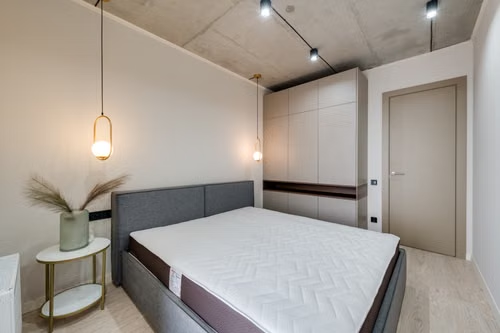
A single ceiling light leaves dark corners, and dark corners make a room feel smaller. A designer at the lighting brand ValueLights, quoted by Homebuilding calls relying on the ceiling light alone a common mistake. Layered lighting fixes this by adding a few softer light sources around the room.
Wall lights or sconces beside the bed are a great space-saving choice because they free up your nightstand. The Living House points out that rechargeable wall lights need no wiring, so you don’t need an electrician.
Choose warm white bulbs, around 2700 to 3000K, for a cozy glow that doesn’t feel harsh.
7. Rug Size for a Small Bedroom: How Big Is Big Enough?
Cost: Low to Medium | Renter-friendly: Yes
A rug that’s too small looks lost, and it quietly points out how little space you have. A properly sized rug pulls the room together.
The Living House suggests placing the rug under the lower half of the bed and making it at least as wide as your bedside tables. The Space adds a useful balance: leave a visible border of floor around the edges so the room doesn’t feel swallowed up.
A tip for beginners: use painter’s tape on the floor to mark the rug size before you buy.
8. Use Vertical Space: Tall Headboards, Wall Storage and Vertical Lines
Cost: Medium | Renter-friendly: Partly
When floor space is tight, look up. Using vertical space makes the ceiling feel higher and gives you storage without taking up the floor.
Easy ways to go vertical:
- Choose a tall headboard that leads the eye upward. Homes & Gardens recommends one with a light, slim profile.
- Use vertical stripes or slatted panels on one wall.
- Add shelves or tall storage that reach toward the ceiling.
- Stack small art pieces in a neat vertical line.
The Home Depot adds a handy caution: avoid mixing strong vertical and horizontal lines on one wall, because mixed lines break the upward flow.
9. Simple, Light Bedding: A Quick Way to Cut Visual Clutter
Cost: Low | Renter-friendly: Yes
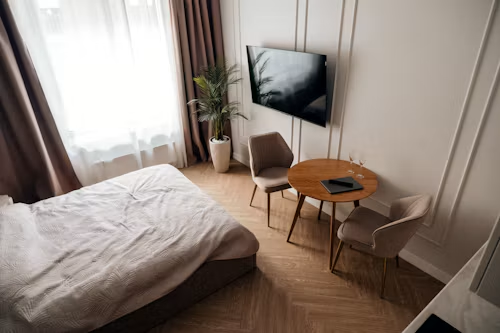
Your bed is the biggest thing in the room, so it has a big effect on how the space feels. Too many throws, blankets and pillows create a cluttered look that makes a room seem smaller.
Choose light, solid colors and breathable fabrics such as cotton or linen. Use fewer pillows and tuck the sheets in neatly. A calm, minimalist bed does a lot of work.
Want a little personality? Add one thin throw across a corner of the bed instead of several layers.
10. Wall Art for Small Bedrooms: Go Large, Not Busy
Cost: Low | Renter-friendly: Yes (use removable hooks)
Many small frames scattered around create visual clutter. Several of the guides we compared, including The Living House, recommend one or two larger pieces of art instead of a busy gallery wall, because a single large piece becomes a calm focal point.
Hang the art so it anchors a piece of furniture, such as above the bed or the dresser. That gives your eye a clear place to rest. It’s also an easy way to add personality to your bedroom decor without adding more stuff.

11. Light Flooring and Rug Ideas for a Small Room
Cost: Medium to High | Renter-friendly: Partly (use a pale rug)
Light flooring reflects more light, which makes the room feel more open. Pale wood tones, light carpet or a light-colored rug all help.
If you’re choosing new flooring, the guide from Woman & Home says wider boards mean fewer visible joins, so the floor looks less busy.
Renting? You can still get the effect with a large, pale rug over a darker floor.
12. Multifunctional Furniture and Hidden Bedroom Storage Ideas
Cost: Medium to High | Renter-friendly: Partly
Good bedroom storage ideas keep clutter out of sight, and less clutter means a bigger-feeling room.
A storage bed with built-in drawers can replace a bulky dresser, a point The Home Depot also makes. A fold-away desk gives you a workspace that disappears when you’re done. Handleless drawers, a sleek look and have clean lines that look less busy.
Think of it this way. If one piece of furniture does two jobs, you need fewer pieces in the room.
Small Bedroom Layout and Design Rules: What to Do When Advice Disagrees
If you’ve read a few small bedroom decorating ideas online, you may have noticed that the advice doesn’t always match. Sliderobes suggests small art prints and curtains that stop above the floor. The Living House recommends large artwork and floor-length curtains. Don’t worry, it isn’t you.
The truth is, many of these tips depend on your room. Here’s a simple rule for each common question.
| Common Question | A Simple Rule to Follow |
|---|---|
| Should curtains touch the floor? | Hang them high and let them reach the floor or stop about 1 inch above. Go shorter only if a radiator or furniture is in the way. |
| Big art or small art? | Choose one or two large pieces. Use small prints only where wall space is tight. |
| Big rug or small rug? | Big enough to sit under the lower half of the bed, with a visible border of floor. |
| Should I paint a feature wall? | Skip it in a very small room. In a narrow room, you can try the far end wall. |
| Light or dark walls? | Light by default. Use a deep color only in an already dark room, and carry it across the walls, ceiling and trim. |
| What color should the ceiling be? | The same as the walls, or one shade lighter. |
| Low bed or tall headboard? | A low frame for low ceilings. A tall headboard works in most rooms, and you can combine a low frame with a tall headboard. |
| One mirror or many? | One large mirror near or opposite a window. |
Swipe left or right to view all columns →
Think of these as starting points. If you’re unsure, try one option, take a photo and compare it with the other.
Where to Put the Bed in a Small Bedroom: Layout and Furniture Arrangement Rules
Bed placement has a big effect on how large the room feels. Here are the common rules designers use for a small bedroom layout.
- Place the bed against the wall opposite the door, or in a corner, as a first try.
- Aim for the “command position”: you can see the door from the bed, without sitting directly opposite it.
- Keep a clear path of about 24 to 30 inches beside the bed. If two people share the bed, make sure both sides are easy to reach.
- Avoid putting the bed in front of a window when you can.
- In a very small room, a full or queen bed can fit better than a king. Measure first.
A corner bed frees up the most floor space. A bed centered on the long wall feels balanced and calm.
These are common design guidelines, not strict laws. Some traditions, such as feng shui, suggest different positions, so pick what feels right for you.
How to Make a Small Bedroom Look Bigger on a Budget (Even if You Rent)
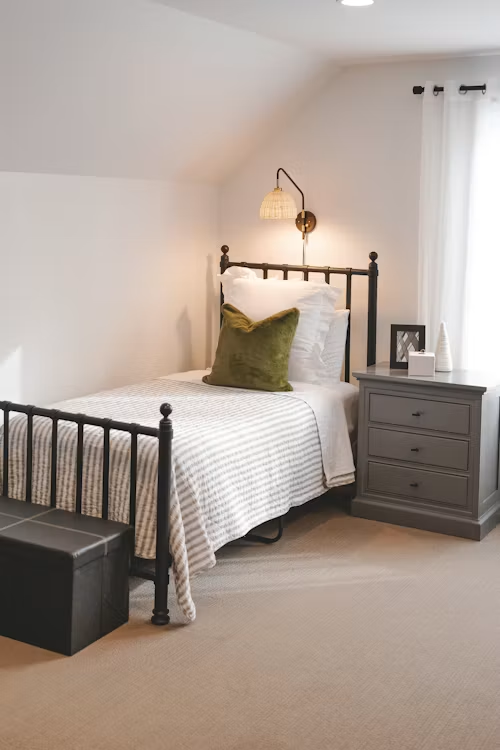
You don’t need to spend a lot, and you don’t need to own your home. Here are the same 12 tips grouped by cost, so you can plan around your budget.
| Budget Level | What to Do | Tips |
|---|---|---|
| Free | Declutter, rearrange the bed and furniture, clear the walkway, open the curtains fully | 1 |
| Low cost | Light bedding, lighter curtains hung higher, a mirror, a correctly sized rug, rechargeable lights, art scaled to the wall | 3, 4, 6, 7, 9, 10 |
| Medium | Slim-legged furniture, a tall headboard, vertical storage, paint if you own the place | 2, 5, 8 |
| Worth the splurge | Pale flooring and multifunctional storage | 11, 12 |
Swipe left or right to view all columns →
Start at the top and work down. Rearranging is a good place to begin, because it costs nothing. You can get a real improvement from the free and low-cost steps alone.
Renter-Friendly Ways to Make an Apartment Bedroom Look Bigger
Renting does limit some changes, but you still have plenty of options. Repainting, changing your bedding, adding mirrors and switching up window treatments can all work in a rental, as long as you check with your landlord before anything that alters the room.
No permission needed:
- Bedding, rugs and curtains on an existing or tension rod
- A leaning floor mirror
- Plug-in or rechargeable lights
- Decluttering and rearranging furniture
Usually needs a yes first:
- Repainting walls
- Drilling or nailing into walls
- New curtain hardware
Removable options: Adhesive hooks and peel-and-stick wallpaper can work well. Test a small hidden patch first so you don’t damage the wall.
A final tip: take photos of the room before you start, and keep any original hardware. It makes it easy to put things back and helps protect your deposit.
7 Small Bedroom Decorating Mistakes That Make a Room Look Smaller
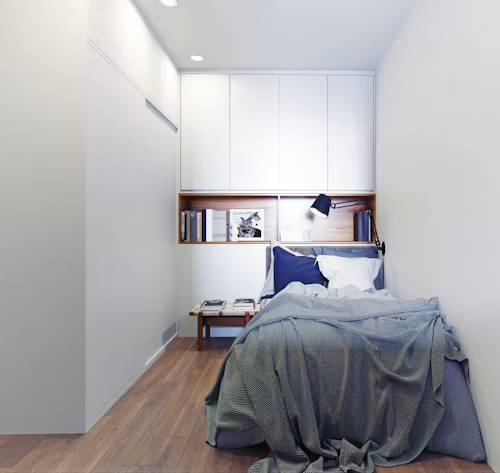
Sometimes the fastest way to improve a room is to stop doing a few things. Here are the most common bedroom decor mistakes, and how to fix each one quickly.
| Mistake | Why It Hurts | Quick Fix | Tip |
|---|---|---|---|
| A rug that is too small | Looks lost and highlights the small size | Use a rug that sits under the lower half of the bed | 7 |
| Heavy, dark curtains | Block light and shrink the window | Swap for light fabric hung high and wide | 4 |
| Furniture in front of the window | Cuts off light and closes the room in | Move it to another wall | 4 |
| One ceiling light only | Leaves dark corners | Add wall or bedside lights with warm bulbs | 6 |
| Too many small decor items | Gives the eye nowhere to rest | Keep a few larger pieces and clear the surfaces | 1, 10 |
| Bulky furniture you can't see under | Hides the floor and adds weight | Choose slim-legged or wall-mounted pieces | 5 |
| Busy patterns on the bed | Makes the biggest item look even bigger | Use light solids or a subtle palette | 9 |
Swipe left or right to view all columns →
If you only fix one thing, fix the clutter. It’s free, it’s fast and it works in almost every room.
Small Bedroom FAQs
What color makes a small bedroom look bigger?
Light, reflective colors such as soft white, warm beige, pale gray, soft green and blush pink. They bounce more natural light around, so the room feels open. Keep the color palette cohesive, and test a sample in your own lighting before you paint.
Does painting the ceiling the same color as the walls make a room look bigger?
Often, yes. One color across the walls and ceiling blurs the edges, so the room feels like one calm space. If that feels too plain, a slightly lighter ceiling is a safe alternative.
Do dark colors make a small bedroom look smaller?
Usually, yes. Dark colors absorb light and can feel closer. A deep color can still work in a room that’s already dark, if you carry it across the walls, ceiling and trim and add good lighting.
Do mirrors make a small bedroom look bigger?
Yes. Mirrors reflect light and add depth. Place one large mirror near or opposite a window, and avoid filling the room with many mirrors.
Do low beds make a room look bigger?
Yes, especially under a low ceiling. A low bed leaves more wall visible and adds a feeling of height. In a room with a high ceiling, a tall headboard helps keep things in proportion.
Final Thoughts: Make a Tiny Bedroom Feel Calm, Airy and Spacious
Making a small bedroom look bigger is mostly about how the room feels, not how many square feet it has. Light, clear floors and a calm look do most of the work.
If you remember just one thing, do the first four tips: declutter, use one light color, add a mirror and hang light curtains. They give the biggest change for the least money.