Your entryway is the first space guests see and the last space you pass before you head out. It sets the tone for your whole home, yet it’s often the most neglected spot.
Here’s the good news: you don’t need a grand foyer or a big budget to fix it. Even a small entryway or a narrow hallway can look polished with a mirror, warm lighting and a proper place for keys, shoes and coats.
This guide shares 30 entryway decorating ideas for small foyers, narrow hallways, apartments and larger entrances. Each idea comes with an approximate cost and a quick “Try this”.
Table of Contents
How to Plan an Entryway: Measure Your Space and Choose a Layout
This is the step most decorating guides skip, and it’s the one that saves you the most money. A console table that’s two inches too deep can turn a narrow hallway into an obstacle course.
Grab a tape measure and a notepad. It takes about five minutes.
Measure these four things first
- Width of the walkway. Measure wall to wall at the narrowest point, including anything that sticks out, like a light fixture.
- Length of the free wall. This decides what size console table, bench or shelf will fit.
- Ceiling height. It tells you whether a pendant light or a tall mirror will work.
- Door swing. Note which way the front door opens, and keep that area clear.
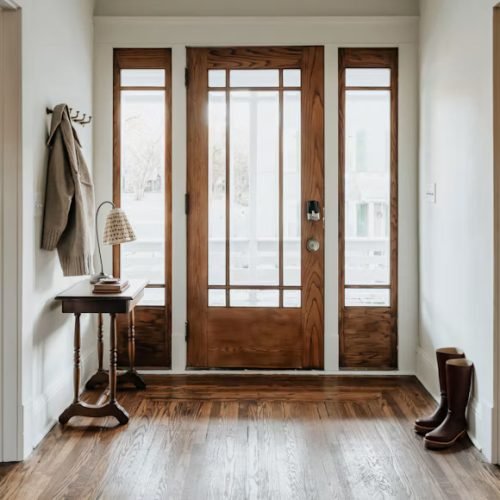
Entryway size guidelines: what's code, and what's just good design
Some numbers below come from building codes or manufacturers. Others are common design rules of thumb. The table says which is which, so you know how much weight to give each one.
| Item | Guideline | Where it comes from |
|---|---|---|
| Walkway width | At least 36 inches (91 cm). About 42 inches (107 cm) feels more comfortable. | The 36-inch minimum for residential hallways is in the International Residential Code. Local codes vary |
| Pendant or chandelier height | Keep at least 7 feet (2.1 m) from the floor to the bottom of the fixture. In an open foyer, hang it at least 6 inches above door height. | Lighting manufacturer guidance |
| Wall sconce height | 60-66 inches (150-165 cm) for 8-foot ceilings, measured to the center of the backplate | Lighting manufacturer guidance |
| Console table depth | 10-14 inches (25-35 cm) for narrow halls | Common design guideline |
| Wall hooks | About 60-66 inches (150-165 cm) for adults, 40-48 inches (100-120 cm) for kids | Common design guideline |
| Mirror above a console | Roughly two-thirds the width of the table | Common design guideline |
| Runner rug | Leave 4-6 inches (10-15 cm) of bare floor on each side | Common design guideline |
Swipe left or right to view all columns →
The 5-step entryway layout formula
Once you have your numbers, use this simple order. It works for almost any entryway or foyer.
- Zone it. Define the space with a rug or a runner.
- Add storage. Choose hooks, a bench or baskets for what you really use.
- Add a seat. Even a slim bench gives people a place to put on shoes.
- Add light. Layer a lamp or wall sconce on top of your ceiling light.
- Add something personal. A photo, a plant or a favorite print makes it feel like yours.
Example: Imagine a 4-foot-wide hallway in a rented apartment. A 12-inch floating shelf, three wall hooks, a long runner and a leaning mirror cover all five steps and still leave a comfortable walking path.
Small Entryway Ideas for Narrow Hallways, Apartments and Tiny Foyers
A small entryway isn’t a problem. It just needs smarter choices and fewer things. These six ideas make the most of every inch, whether you have a narrow hallway, a tiny foyer or no foyer at all.
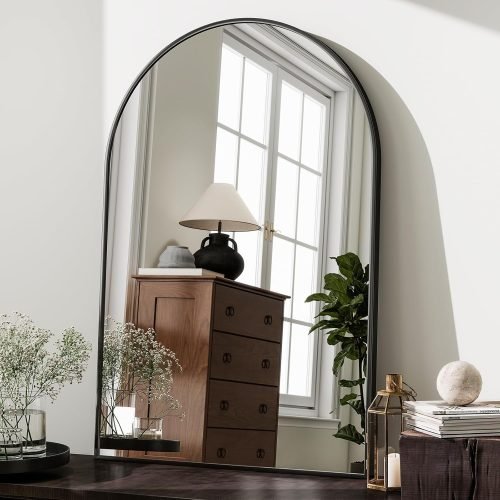
1. Lean a Large Mirror to Make a Narrow Entryway Look Wider
Cost: $50-$150 | Best for: small, narrow
A big mirror is the fastest way to make a small entryway feel bigger. It reflects light and adds depth, so a narrow hallway feels less boxed in.
A full-length leaning mirror also gives you a quick outfit check on your way out the front door.
Try this: Place the mirror across from a window or light source, so it bounces natural light down the hall.
2. Install a Floating Console Table or Wall Shelf to Save Floor Space
Cost: $30-$120 | Best for: small, narrow
When floor space is tight, go up the wall. A slim floating shelf gives you a spot for keys, mail and a small plant without blocking the walkway.
It also keeps the floor clear, which makes the whole foyer look larger.
Try this: Choose a shelf 8-12 inches (20-30 cm) deep, and style it with three things: something tall, something round and something green.
3. Lay a Slim Entryway Runner Rug to Define the Space
Cost: $40-$150 | Best for: narrow, high-traffic
A long entryway runner does two jobs. It catches dirt at the door, and it makes a short, narrow hall look longer.
It also marks the entry as its own zone, which helps if your front door opens straight into the living room.
Try this: Pick a washable, low-pile runner so it lies flat and doesn’t catch the door.
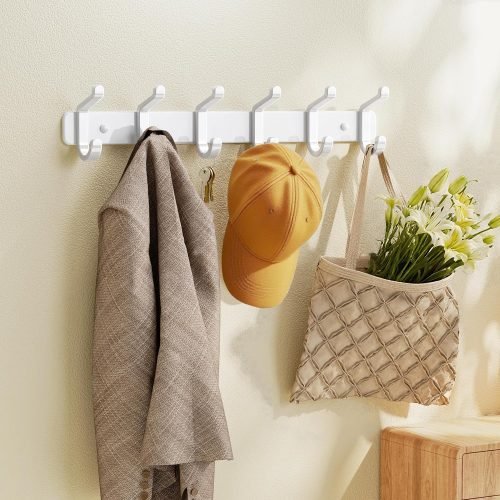
4. Swap the Coat Rack for Wall Hooks in a Small Foyer
Cost: Under $50 | Best for: small foyers, renters
Freestanding coat racks take up floor space and tip over. Wall hooks hold the same coats, bags and hats while keeping the floor clear.
A row of good-looking hooks in wood or brass also counts as decor.
Try this: Mount hooks at about 60-66 inches (150-165 cm) for adults, and add a lower row for kids.
5. Turn an Under-Stair or Corner Nook into a Mini Entry
Cost: $50-$150+ | Best for: awkward spaces
That odd corner or the space under the stairs is free real estate. A small bench, a few shelves and a cushion turn it into a cozy drop zone.
Example: Imagine a home where the front door opens beside the stairs. A 24-inch bench and two hooks create a full entry in a spot that used to be wasted.
Try this: Measure the nook first, then choose a bench that leaves a few inches of breathing room on each side.
6. Create an Entry Zone When You Have No Foyer
Cost: $50-$200 | Best for: apartments, open plans
Many homes and apartments have no foyer at all. You step straight into the living room. You can still create an entryway by marking out a zone.
A rug by the door, a narrow console table behind the sofa or a tall open shelf all work as soft dividers.
Try this: Put a console table behind the sofa that faces the door. It instantly reads as an entry.
Entryway Storage Ideas: Benches, Hooks and Shoe Storage That Work
If your entryway always looks messy, it’s rarely a decor problem. It’s a storage problem. When every coat, shoe and set of keys has a home, the space stays calm without much effort.
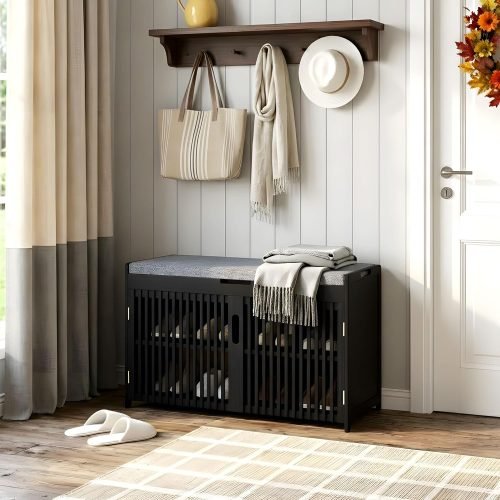
7. Choose an Entryway Bench with Hidden Shoe Storage
Cost: $100-$250 | Best for: families, small entryways
A storage bench is a seat and a shoe cupboard in one. Sitting down to put on shoes gets easier, and the clutter disappears under the lid or into the cubbies.
Try this: Look for a bench with removable baskets or drawers, so you can pull them out and wash them.
8. Tuck Woven Baskets Under the Console Table
Cost: Under $50 | Best for: any size
Baskets are the easiest storage upgrade there is. They hide shoes, umbrellas, scarves and dog leashes, and they add warm texture at the same time.
Try this: Use one basket per person. Everyone gets their own spot, and nothing piles up.
9. Build Cubbies for a Mudroom-Style Family Drop Zone
Cost: $150+ | Best for: large entryways, families
If you have kids, cubbies are a game changer. Each person gets a hook, a shelf and a basket, so backpacks and boots stop landing on the floor.
This works just as well in a back-door mudroom as it does in a front foyer.
Example: A family of four can share one wall with four labeled cubbies. Morning chaos drops fast.
Try this: Place the hooks and cubbies at kids’ height so they can use them without help.
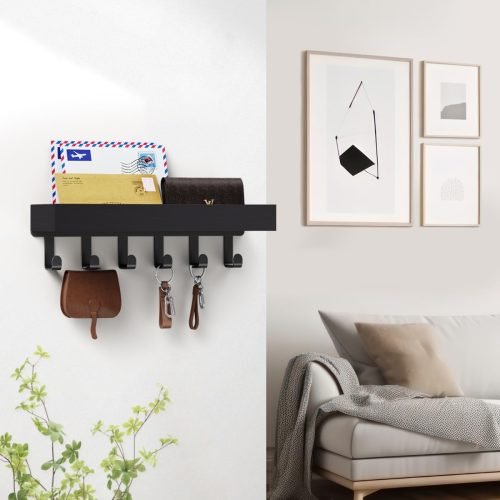
10. Set Up a Key Tray and Mail Organizer by the Front Door
Cost: Under $50 | Best for: any size, renters
Half of entryway clutter is small stuff: keys, mail, sunglasses and wallets. A tray, a bowl or a small wall organizer gives all of it a landing spot.
Try this: Pair a key tray with a wall-mounted mail slot, so bills and keys never mix with your decor.
11. Use Multi-Functional Entryway Furniture to Do More with Less
Cost: $100-$250 | Best for: small spaces
In small spaces, every piece should work twice. A slim console with drawers, a ladder shelf with bins or a bench with a shoe rack all give you storage without extra furniture.
Try this: Before you buy, ask: “Does this hold something and look good?” If it only does one, skip it.
Entryway Tips for Kids, Pets and Wet Weather
Real homes get muddy, wet and noisy. A few small choices make a big difference.
- Pick washable rugs. They handle muddy paws and wet boots, and they go in the machine.
- Add a boot tray. A simple tray by the door catches water and keeps floors dry.
- Hang a leash hook. One hook near the door keeps the dog’s leash easy to grab.
- Choose wipeable surfaces. Painted wood and sealed finishes clean up faster than fabric.
- Keep a small umbrella stand. In rainy months, it saves your floor.
How to Style an Entryway Table: Console Table Decor That Looks Great
The entryway table (often a slim console table) is the focal point of most foyers. It’s also the spot that turns into a dumping ground. Here’s how to style it so it looks good and works hard.
The 5-layer formula for styling an entry table
Use one item from each layer. You’ll end up with a console that looks collected, not cluttered.
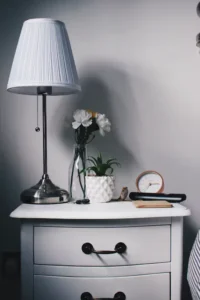
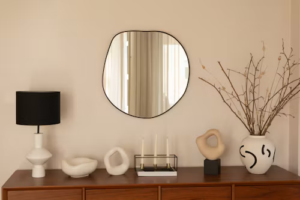
- Something tall. A table lamp, a vase of branches or a piece of art leaning behind the table.
- Something wide and low. A tray or a short stack of books to anchor the group.
- Something living. A small plant or fresh flowers.
- Something useful. A key bowl, a catch-all dish or a mail holder.
- Something personal. A framed photo or a keepsake that says “this is our home”.
Example: On a 40-inch console, place a lamp on the left, a tray with keys in the middle and a small vase on the right. Hang a mirror above, and the whole table looks finished.
Quick fixes if your console table looks cluttered
- Clear it off, then add back. Start with the lamp, then add one layer at a time.
- Vary the heights. A row of same-size objects looks flat. Mix tall, medium and short.
- Leave breathing room. Empty space is part of the design, so don’t fill every inch.
- Move the daily clutter. Keys and mail go in the tray, and shoes go in baskets underneath.
Entryway Wall Decor Ideas: Mirrors, Gallery Walls, Wallpaper and More
Blank walls are a big opportunity. You don’t need much to turn them into a warm welcome. Pick one idea, do it well and let the rest of the foyer stay simple.
12. Hang a Gallery Wall to Show Off Your Personality
Cost: $50-$150 | Best for: large walls, staircases
A gallery wall turns family photos, travel prints and favorite art into one eye-catching display. It’s a great fit for the wall beside a staircase.
Try this: Stick to one color palette or one frame color, so a mix of images still looks organized.
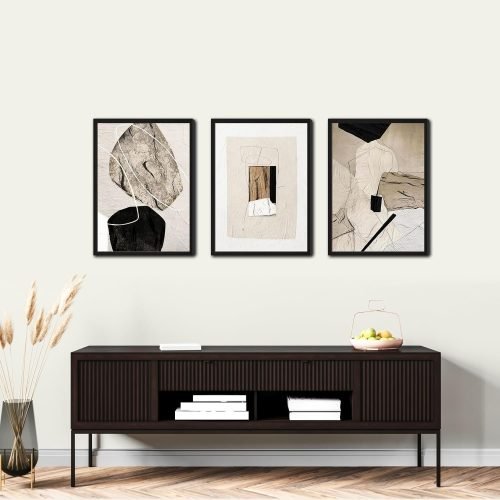
13. Layer Wall Art Behind Your Entry Table
Cost: $30-$120 | Best for: any size
Hanging two or three prints behind an entry table adds height and interest. Pair the art with a mix of tall and short objects on the table, and the wall and the table feel connected.
Try this: Choose prints in different sizes but similar colors. Lean one against the wall for a relaxed look.
14. Paint an Accent Wall or the Inside of Your Front Door
Cost: Under $50 | Best for: any size, homeowners
Paint is the cheapest big change you can make. One bold wall, or just the inside of your front door, gives the entryway personality fast.
Try this: Test two or three paint samples and look at them in morning and evening light before you commit.
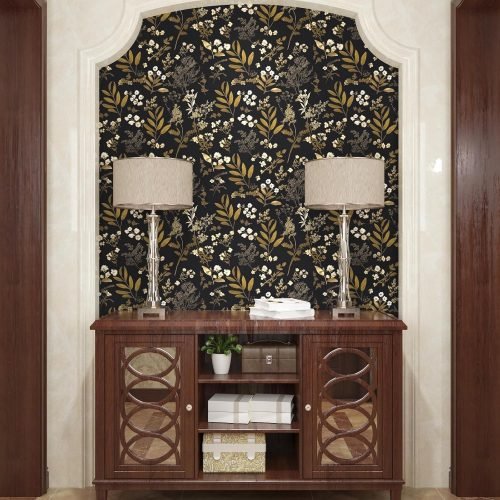
15. Add Wallpaper for a Bold Entryway Statement
Cost: $50-$300+ | Best for: small entryways, bold style
Small entryways are the perfect place for a bold print. You only need one or two rolls, so it feels like a splurge without a huge price tag.
Try this: If a full wall feels risky, paper just the wall behind the console table or the back of a nook.
16. Add Wainscoting or Picture-Frame Molding for Timeless Charm
Cost: $150+ | Best for: homeowners, classic style
Wainscoting, picture-frame molding or board-and-batten make a plain wall look custom. They add texture and a sense of quality that paint alone can’t.
Try this: Paint the lower panels a deeper shade and keep the upper wall lighter. It feels classic and grounded.
17. Bring In Natural Textures Like Rattan, Wicker and Jute
Cost: $30-$120 | Best for: boho and farmhouse looks
Natural textures such as rattan, wicker and jute soften a hard entry and make it feel welcoming. Think a rattan mirror, a woven wall basket or a jute rug.
Try this: Mix two natural textures with one smooth material, like glass or metal, so the look feels layered instead of flat.
Entryway Lighting, Rug and Flooring Ideas for a Warm, Welcoming Foyer
Entryways are often dark and hard-floored, which makes them feel cold. Good lighting and soft textures fix both problems fast.
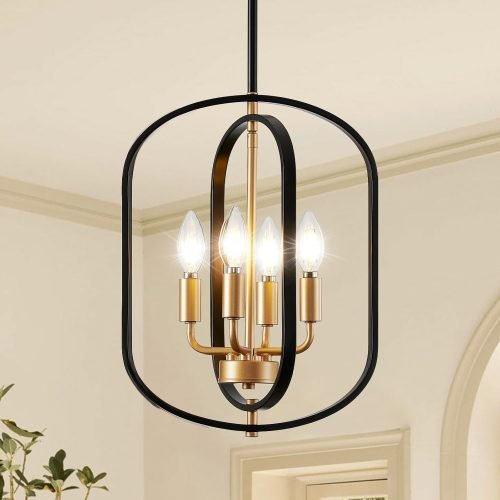
18. Hang a Statement Pendant Light or Chandelier
Cost: $80-$300+ | Best for: higher ceilings, larger foyers
A bold pendant light draws the eye up and gives even a simple entry a sense of importance.
Mind the height. Lighting makers advise keeping at least 7 feet (2.1 m) between the floor and the bottom of a fixture where people walk. In an open foyer or hallway, hang it at least 6 inches above door height. With an 8-foot ceiling, a flush or semi-flush light is the safer choice.
Try this: Hang the pendant in the center of the entry, so the front door and any interior doors can swing open freely.
19. Add Wall Sconces on Either Side of a Mirror
Cost: $60-$200 | Best for: narrow, small entryways
Wall sconces give you light without taking up any table space, which is ideal in a narrow hall. Placed beside a mirror, they create a flattering glow.
For an 8-foot ceiling, a common guideline is to mount sconces about 60-66 inches (150-165 cm) from the floor, and to position them so nobody can see the bare bulb.
Try this: Choose plug-in sconces with a cord cover if you can’t do any wiring.
20. Set the Mood with a Table Lamp or Candles
Cost: Under $50 | Best for: any size, renters
Overhead light alone feels flat. A small table lamp on the console adds a soft, welcoming glow, especially when you come home after dark.
Try this: Choose warm-white bulbs (usually labeled around 2700K-3000K) for a cozy feel, and add a lantern or candles near the door for extra charm.
21. Layer Rugs for Color, Texture and Warmth
Cost: $60-$250 | Best for: large or open entryways
Layering a small rug over a larger one adds warmth and pattern. It also helps mark out an entry in an open layout.
Try this: Put down a neutral base rug first, then a smaller patterned rug on top, and secure both with a non-slip pad.
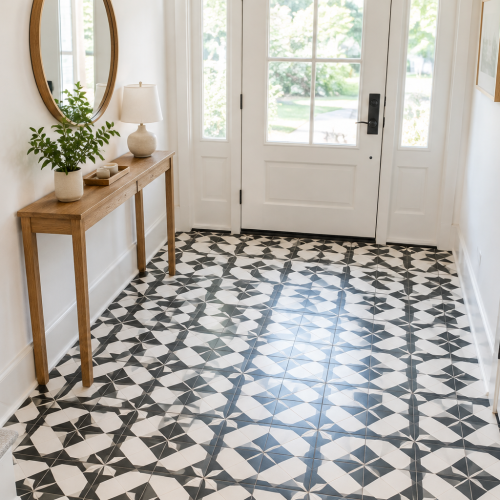
22. Make the Floor a Feature with Patterned Tile
Cost: $150+ | Best for: renovations
If you’re renovating, the entryway floor is a great place for personality. Geometric or patterned tile looks striking, hides dirt and holds up to heavy traffic.
Try this: Keep the walls and furniture simple, so the floor stays the star.
Entryway Decor Styles: Modern, Farmhouse, Boho and Vintage
Once the basics are in place, style is what makes the space feel like yours. You don’t have to stick to one look, but it helps to know which direction you’re leaning.
23. Go Modern Minimalist for a Clean, Calm Entry
Cost: Under $50-$200 | Best for: small, modern homes
The minimalist look is about fewer pieces, clean lines and plenty of open space. Think a slim console, one mirror and a single plant.
Try this: Limit yourself to three colors and avoid anything that doesn’t have a clear job.
24. Choose Farmhouse Charm with Wood and Warm Neutrals
Cost: $50-$250 | Best for: cozy, traditional homes
Farmhouse style is warm and practical. Picture a wooden bench, shiplap or paneled walls, a woven basket and a vase of seasonal branches.
Try this: Add one vintage-looking piece, like a wood-framed mirror or a metal lantern, for that lived-in feel.
25. Layer in Boho Texture and Pattern
Cost: $50-$200 | Best for: eclectic styles, renters
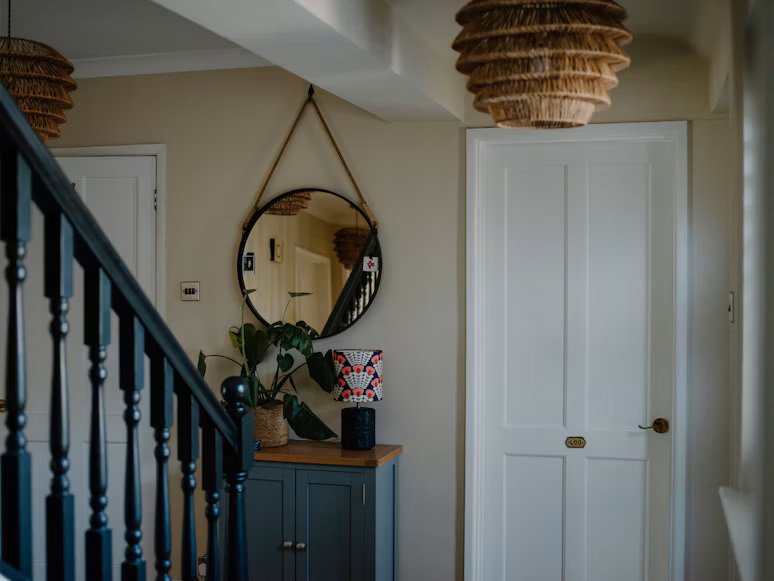
Boho entryways are layered and relaxed. Mix woven textures, a patterned rug, hanging plants and a few handmade pieces.
Try this: Pick one or two main colors and repeat them in the rug, pillows and art. It keeps the layers from feeling messy.
26. Add Vintage and Thrifted Finds for Character
Cost: Under $50-$150 | Best for: budgets, one-of-a-kind style
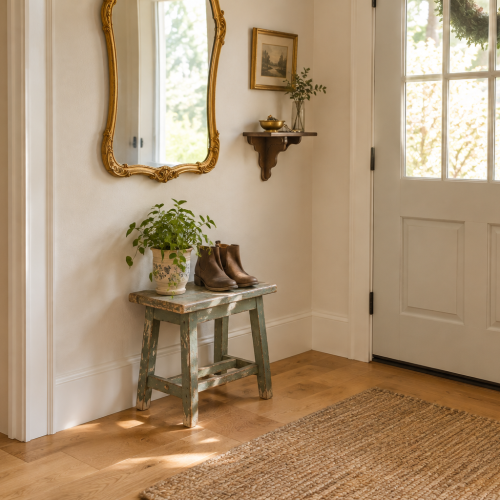
Nothing makes an entryway feel more personal than a vintage find. An old mirror, a wooden stool or a small dresser tells a story that new furniture can’t.
Example: A $30 thrifted wooden stool, sanded and given a coat of paint, becomes a plant stand or a spot for shoes.
Try this: Check local markets, thrift stores and online marketplaces, and mix one old piece with newer ones.
27. Play with Symmetry or Embrace Asymmetry
Cost: Under $50-$150 | Best for: any size
Symmetry feels classic and calm. Think matching lamps on a console or two identical plants flanking a door.
Asymmetry feels relaxed and modern. Balance a heavy item on one side with art or a tall branch on the other.
Try this: If you want a classic look, use pairs. If you want a casual look, use an odd number of objects.
Renter-Friendly and Budget Entryway Ideas (No Drilling Needed)
Renting doesn’t mean your entryway has to stay boring. These ideas are removable, low-cost and damage-free, so you can take them with you when you move.
28. Use No-Drill Hooks, Shelves and Plug-In Sconces
Cost: Under $50-$100 | Best for: renters
Adhesive hooks, tension-rod shelves and plug-in wall sconces give you storage and light without a single hole. Many are designed to peel off cleanly.
Try this: Check the weight limit on the packaging, and clean the wall with rubbing alcohol before sticking anything on.
29. Try Peel-and-Stick Wallpaper or Removable Decals
Cost: $30-$100 | Best for: renters
Peel-and-stick wallpaper is a renter’s best friend. You get a bold pattern in a weekend, and it comes off when you leave.
Try this: Test a small patch in a hidden corner first, and check your lease or landlord rules before covering a full wall.
30. Thrift and DIY Your Way to a Stylish Entryway
Cost: Under $50 | Best for: tight budgets
You can create a great entry for very little. A thrifted mirror, a painted stool and a basket you already own can look intentional when styled well.
Example: Spray-paint a mismatched frame gold, add a print you love and hang it with a removable strip. Total cost: under $15.
Try this: Make a “under $50” shopping list: one mirror, one tray, one plant. Buy those three first.
How to Adapt These Entryway Ideas to Your Home, Climate and Season
Every home is different. Here’s how to tweak the ideas above so they actually work where you live.
If your home is shoes-off
In many homes, shoes come off at the door. That changes what you need.
- Add a shoe bench or closed shoe cabinet so pairs don’t pile up.
- Place a washable mat just inside the door, where people step out of their shoes.
- Keep a small basket of house slippers within reach, especially for guests.
If you live in a hot, dusty or humid climate
Dust and heat are tough on entryways. Choose materials that are easy to clean and hold up well.
- Pick tile, sealed wood or washable rugs over deep-pile carpet.
- Keep fabrics simple, so they can be shaken out or washed often.
- Choose faux plants or hardy plants like snake plants that survive low light and heat.
If you live in an apartment with no entry at all
A rug, a wall-mounted shelf and a row of hooks are enough to mark a tiny entry zone. Add a mirror, and the corner starts to feel like a real entrance.
Seasonal Entryway Refresh Ideas for Fall and the Holidays
You don’t need to redecorate every season. A few simple swaps keep the entry feeling fresh.
- Fall: A vase of dried stems or branches, a pumpkin on the console and a cozy throw on the bench.
- Winter holidays: A wreath on the inside of the door, warm lights and a small lantern by the entry.
- Spring and summer: Fresh flowers, lighter pillows and a woven basket for shoes or sandals.
Common Entryway Decorating Mistakes to Avoid
Even good ideas can go wrong. These are the most common slip-ups, and how to fix them.
- Too much clutter. Limit the console to three or four items, and give everything else a home.
- Poor lighting. One ceiling light isn’t enough. Add a lamp or sconce.
- Oversized furniture. If you have to squeeze past it, it’s too big.
- A rug that’s too small. A tiny rug looks like a doormat. Choose a runner that fits the space.
- Ignoring storage. Pretty decor won’t help if your shoes and bags have nowhere to go.
- Blocking the door. Keep the door swing and walking path clear.
Entryway Decorating FAQs
How do I decorate my entryway?
Start with the basics: a rug to define the space, a mirror for light and a spot to hang or store everyday items. Then add one focal point, such as art or a lamp, and a personal touch like a plant or a photo.
How do I decorate a small entryway?
Use the walls instead of the floor. A slim floating shelf, wall hooks and a leaning mirror give you function and style without blocking the walkway. Keep furniture slim, and stick to a few well-chosen pieces.
What should I put in an entryway or foyer?
Most entryways benefit from four things: somewhere to sit, somewhere to hang coats, a surface for keys and a light source. Add a rug, a mirror and a plant, and you have a welcoming, practical space.
How do I make my entryway look nice?
Focus on lighting, order and one standout piece. Add warm light at eye level, keep surfaces tidy, and choose a single feature like a bold mirror, wallpaper or a colorful runner.
How do I decorate an entryway without a foyer?
Mark out a small zone near the door with a rug, a narrow console or shelf and a few hooks. A console behind a sofa that faces the door also works as an instant entry.
Final Thoughts: Make Your Entryway Work for You
A great entryway balances function and personality. You don’t need to do everything on this list. Pick two or three ideas that fit your space, your budget and the way you live.
Start small. A mirror, a tray and a warm lamp can change how your home feels the moment you walk in.