Your master bedroom is the first room you see in the morning and the last one you see at night. So why is it so often the last room we decorate?
If that sounds familiar, relax. You’re not behind, and you don’t need a designer or a big budget. You just need a simple plan and a handful of smart choices.
This guide to decorating a master bedroom shows you how to decorate a master bedroom step by step. You’ll get 15 master bedroom decorating ideas, real sizing tips (like how big your bedroom rug should be), budget advice, and the mistakes that trip people up most.
Table of Contents
Quick Answer: How Do You Decorate a Master Bedroom?
To decorate a master bedroom, choose a calm color scheme, make the bed the focal point, and layer bedding, lighting and textures for comfort. Add floor-length curtains, a rug that extends 18 to 24 inches beyond the bed, and wall art that feels personal. Start with the big pieces, then finish with the small details.
Master Bedroom Decorating Plan: 5 Steps to Follow Before You Shop
Before you buy a single pillow, take ten minutes to plan. This one habit saves more money than almost any shopping trick, because it stops you from buying pieces that do not work together.
Step 1: Set a Bedroom Decor Budget and Shopping List
Decide how much you want to spend in total. Then write down what you actually need, like bedding, curtains, a rug and lamps.
Tip: Put the biggest share of your budget into what you touch and see most. For most people, that means quality bedding and curtains.
Step 2: Choose a Master Bedroom Color Scheme and Mood
Pick two or three colors and stick with them. A calm bedroom color scheme usually has one main color, one softer supporting color and one small accent.
For example: warm white walls, sage green bedding and a touch of brass in the lamps.
| Mood | Color ideas | Pairs well with |
|---|---|---|
| Calm and airy | Warm white, greige, soft sage | Linen bedding, light wood |
| Soft and serene | Muted blue, pale gray-blue, white | Cotton bedding, brushed nickel |
| Warm and cozy | Warm beige, terracotta, cream | Knit throws, brass lamps |
| Dark and moody | Deep green, navy, charcoal | Velvet cushions, warm lighting |
Swipe left or right to view all columns →
Step 3: Pick a Focal Point (Usually the Bed)
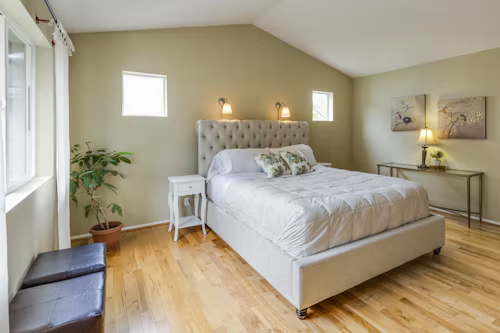
In most bedrooms, the bed is the star. Everything else should support it. If your bed sits against a plain wall, that wall is where your best decor belongs.
Step 4: Measure Your Room Size and Shape
A small, square room and a long, narrow room need different layouts. Measure the room, the walls and the windows before you shop.
Leave at least 24 inches of walking space around the bed, and closer to 30 inches if you can, so the room never feels crowded.
Step 5: Plan Your Master Bedroom Layout
Sketch it on paper or use a free room-planner app. Place the bed first, then the nightstands, then the dresser and any chair.
Free checklist idea: Offer a small printable version of these five steps so readers can save it. It also makes a great Pinterest pin.
15 Master Bedroom Decorating Ideas for a Cozy, Luxe Look
Here are our favorite master bedroom decor ideas, in the order we would tackle them. Each one has a quick tip, a common mistake to avoid and a picture idea.
1. Choose Calming Wall Colors and Paint for a Relaxing Bedroom
Color sets the mood faster than anything else in the room. For a relaxing bedroom, try warm neutrals, soft greens or muted blues.
A simple example: a warm greige wall with white trim and natural linen bedding feels peaceful and never goes out of style.
Tip: Paint a large sample (about 2 feet wide) on the wall and look at it in the morning and at night. Color changes a lot with light.
Mistake to avoid: Choosing a color from a tiny paint chip. It almost always looks different on the wall.
2. Add an Accent Wall Behind the Bed
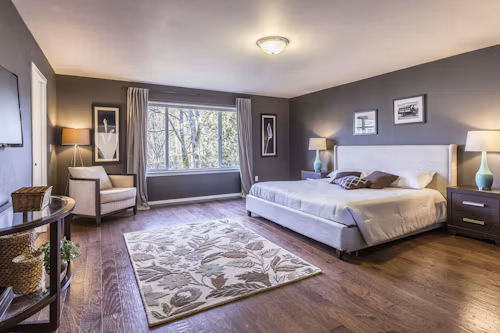
An accent wall gives your bedroom personality without overwhelming it. Paint, wood paneling or wallpaper all work well.
Choose the wall behind the bed, because it is the first thing you see when you walk in.
Mistake to avoid: Adding accent colors to several walls. One is enough.
3. Make the Bed the Focal Point With a Statement Headboard
A good headboard makes the whole bed feel finished. Upholstered, wooden or even a simple wall-mounted panel can work.
If you don’t want to buy a new bed, add a wall-mounted headboard or a large piece of art above the bed instead.
Tip: Choose a headboard slightly wider than your mattress. It looks more balanced.
4. Layer Bedding, Throws and Pillows for a Cozy, Hotel-Style Bed
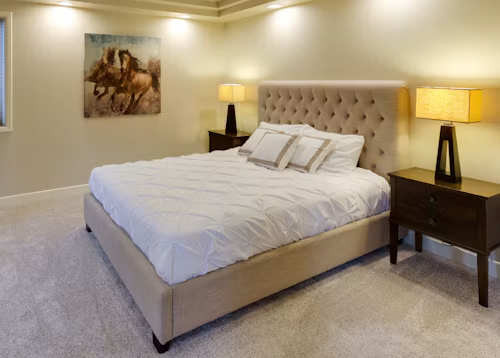
This is where your bedroom starts to look cozy and expensive. Layering simply means combining a few types of fabric.
A simple recipe for a queen bed:
- 2 sleeping pillows in white or neutral pillowcases
- 2 larger Euro pillows behind them
- 1 or 2 decorative cushions in a color or texture you love
- A throw blanket folded at the foot of the bed
Fabric tip: Cotton is breathable, linen feels relaxed and natural, and velvet adds a touch of luxury in cooler months.
Mistake to avoid: Using too many patterns. Keep one pattern and mix it with solid colors.
5. Frame the Room With Floor-Length Bedroom Curtains
Long curtains make a bedroom look taller, softer and more finished. They also help block light for better sleep.
Here is the easy rule:
- Hang the rod about 4 to 6 inches above the window frame, or closer to the ceiling if you want the room to feel taller.
- Extend the rod at least 3 to 6 inches past each side of the frame. Going 8 to 12 inches wider makes the window look bigger and lets in more light.
- Let the curtains touch the floor or stop about half an inch above it.
Blackout or linen? Choose blackout curtains if early light wakes you up. Choose soft linen for a bright, airy feel, or layer sheers behind heavier panels.
Mistake to avoid: Hanging curtains right at the top of the window frame. It makes the ceiling look lower.
6. Choose the Right Bedroom Rug Size for Your Bed
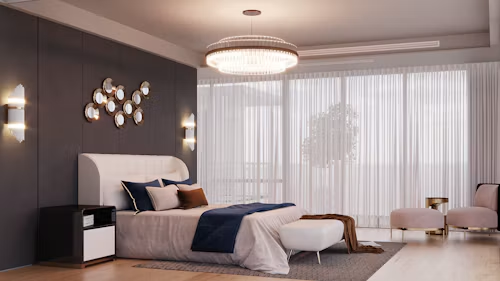
A bedroom rug adds warmth and makes the bed feel grounded. It also feels lovely under bare feet in the morning.
The key is size. Your rug should extend about 18 to 24 inches beyond the sides and foot of the bed. Some designers go as far as 36 inches on a queen or king bed if the room allows it.
| Bed Size | Common Rug Size | Good to Know |
|---|---|---|
| Twin or full | 5 x 8 or 6 x 9 feet | Keeps the walkway clear in small rooms |
| Queen | 8 x 10 feet | The most common choice; 6 x 9 can work in a tight room |
| King | 9 x 12 feet | 8 x 10 is the smallest size that works well |
Swipe left or right to view all columns →
Tip: Choose a low-pile or flatweave rug. It is easier to vacuum under the bed, and a rug pad keeps it from slipping.
Mistake to avoid: Choosing a rug that is too small. A tiny rug makes the whole room look unfinished.
7. Style Bedside Tables and Nightstands With the Rule of Three
Your nightstands should sit at about the same height as the top of your mattress, give or take a few inches. That keeps everything within easy reach.
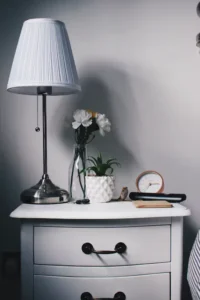
Style each one with the rule of three: one lamp, one small decorative item and one useful item, like a book or a tray.
Tip: Matching nightstands look classic. Two different ones can look charming if they share the same color or height.
Mistake to avoid: Overloading the surface. Leave a little empty space so it feels calm.
8. Layer Bedroom Lighting for a Warm, Relaxing Glow
One bright ceiling light can make a bedroom feel like an office. Layered lighting is the secret to a relaxing atmosphere.
Use three types:
- Ambient light: a ceiling light or pendant, ideally on a dimmer
- Task light: bedside lamps or wall sconces for reading
- Accent light: a small lamp or string light for a soft glow
Tip: Choose warm white bulbs (about 2700K to 3000K). Sleep experts recommend warm, dim light in the evening, and it simply feels cozier too.
Mistake to avoid: Relying only on the overhead light, or using cool white bulbs in a room where you wind down.
9. Hang Wall Art Above the Bed at the Right Height
The wall above your bed is prime real estate. A large piece of art or a gallery wall adds personality right away.
A few simple guidelines:
- Choose art about two-thirds the width of your bed.
- Hang it 6 to 10 inches above the headboard.
- If you use a gallery wall, keep the whole group about the same width as the bed.
Mistake to avoid: Hanging art too high. It should feel connected to the bed.
10. Use Mirrors to Make a Bedroom Look Bigger and Brighter
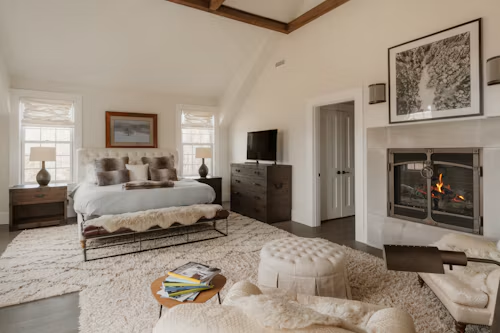
A mirror makes the room feel larger and brighter. This is especially helpful in a small master bedroom.
Place a mirror across from a window so it reflects natural light. A tall leaning floor mirror or a round wall mirror both look lovely.
Mistake to avoid: Placing a mirror where it reflects clutter. Check what it reflects before you hang it.
11. Add a Cozy Seating Area: Armchair or Bench
A small seating spot turns a bedroom into a true retreat. It does not need much space.
Try an armchair with a throw, or a bench at the foot of the bed. The bench is also handy for folded blankets and putting on shoes.
Tip: Even a single chair in a corner makes the room feel more complete.
12. Bring in Plants and Natural Textures for a Calm Bedroom
Plants add life and softness. Low-maintenance options like a snake plant, pothos or ZZ plant cope well with lower light.
Not a plant person? Try dried stems in a vase, a wooden tray or a woven basket for natural texture.
Mistake to avoid: Choosing a plant that needs bright sun when your bedroom is dim.
13. Try a Painted or Wallpapered Ceiling for Subtle Drama
The ceiling is often forgotten, but it can add real drama. Try a soft paint color or wallpaper in a subtle pattern.
A slightly darker ceiling can make a large room feel cozier.
Tip: Start with paint. It is easy to change if you change your mind.
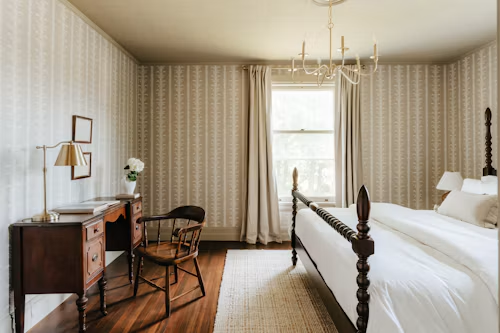
14. Add Stylish Bedroom Storage That Looks Like Decor
Storage keeps your master bedroom calm. The goal is storage that looks like decor.
Ideas include a storage trunk at the foot of the bed, a dresser topped with a mirror, floating shelves, or baskets under a bench.
Mistake to avoid: Leaving things piled on a chair or the floor. Give everything a home.
15. Finish With Personal Decor Touches That Feel Like You
This is the part that makes the room feel like yours. Add framed photos, candles, a favorite stack of books or art you love.
Think of it as the final layer. If the room still feels plain, add one meaningful piece at a time.
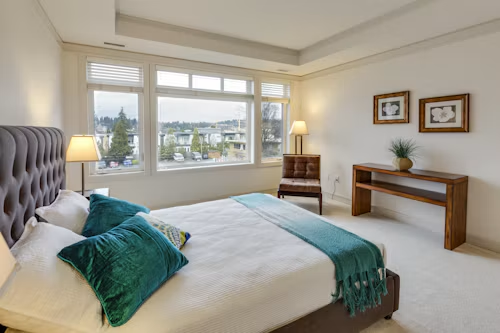
Quick Sizing Cheat Sheet for Rugs, Curtains, Art and Lighting
These are guidelines, not strict rules, so adjust them to your room.
| Item | Guideline |
|---|---|
| Walking space around the bed | At least 24 inches, closer to 30 if possible |
| Rug under the bed | Extends 18 to 24 inches past the sides and foot |
| Queen bed rug | 8 x 10 feet |
| King bed rug | 9 x 12 feet (8 x 10 minimum) |
| Curtain rod height | About 4 to 6 inches above the window frame, or higher |
| Curtain rod width | At least 3 to 6 inches past the frame on each side |
| Curtain length | Floor-length, or about half an inch above the floor |
| Art above the bed | About two-thirds of the bed width, 6 to 10 inches above the headboard |
| Nightstand height | About level with the mattress top |
| Bulb color | Warm white, about 2700K to 3000K |
Swipe left or right to view all columns →
How to Decorate a Small Master Bedroom vs. a Large One
Room size changes the rules a little. Here is a simple way to think about it.
Small Master Bedroom Ideas: Make the Room Feel Bigger
- Choose light colors to keep the room feeling open.
- Use furniture with built-in storage, like a bed with drawers.
- Add a large mirror to reflect light.
- Use wall-mounted lamps or sconces to save nightstand space.
- Keep the rug and curtains simple, with fewer patterns.
Don’t shrink your bed just to fit more furniture. A good bed matters more than extra pieces.
Large Master Bedroom Ideas: Make the Space Feel Cozy
- Create zones, such as a sleeping area and a small sitting area.
- Use a larger rug to anchor the bed.
- Add a bench, a chair or a small desk to use the extra space.
- Don’t push everything against the walls. Float some furniture so the room feels intentional.
Master Bedroom Styles: Neutral, Boho, Dark and Moody, and Modern
Not sure what look you like? Here are four popular master bedroom design ideas, with the key pieces to get started.
Neutral and Minimalist Master Bedroom
Warm whites, beige and simple lines. Key pieces: linen bedding, a woven rug and soft lamps.
Boho and Textured Master Bedroom
Natural materials and lots of layers. Key pieces: macramé, rattan, patterned throws and plants.
Dark and Moody Master Bedroom
Deep green, navy or charcoal walls. Key pieces: matte paint, warm lighting and velvet cushions.
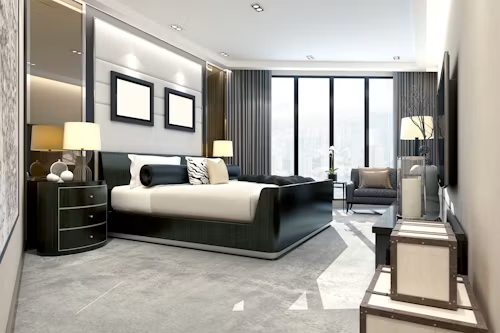
Modern and Luxe Master Bedroom
Clean lines with rich fabrics. Key pieces: an upholstered headboard, metallic accents and a statement lamp.
Decorating a Master Bedroom on a Budget: Where to Splurge and Save
You don’t need to do everything at once. Here is how to spend wisely.
Where to Splurge
- Bedding and a comfortable mattress
- Curtains, because they change the look of the whole room
Where to Save
- Accessories like vases and candles
- Art prints you can frame yourself
- Pillow covers instead of new pillows
Quick, Low-Cost Updates
- Repaint one wall
- Rearrange your furniture
- Swap lamp shades or bulbs
- Add a throw and two new cushion covers
Common Master Bedroom Decorating Mistakes to Avoid
These five mistakes show up in bedrooms of every size, and they are all easy to fix.
- A rug that is too small. Go bigger so it extends past the bed.
- Curtains hung too low. Raise the rod and let the panels reach the floor.
- Too many patterns. Stick to one main pattern and add solids.
- Overcrowded furniture. Leave room to walk comfortably.
- Only overhead lighting. Add lamps and warm bulbs.
Master Bedroom Decorating FAQs: Your Questions Answered
What color is best for a master bedroom?
Soft, calming colors work best, such as warm neutrals, sage green and muted blue. They help the room feel relaxing, and they are easy to pair with different bedding and decor styles.
How do I make my master bedroom look luxurious?
Focus on layered bedding, warm lighting and floor-length curtains. Choose quality fabrics like linen or velvet, add a statement headboard, and keep surfaces uncluttered. A few well-chosen pieces look more luxurious than many small ones.
What should I put above the bed?
A large framed print, a gallery wall or a mirror works well. Choose art about two-thirds the width of your bed and hang it 6 to 10 inches above the headboard so it feels connected to the bed.
How can I decorate a master bedroom on a small budget?
Start with bedding, curtains and lighting, since they make the biggest difference. Then add affordable touches like fresh paint, a new throw and framed prints. Do it in stages instead of all at once.
What are the must-have items in a master bedroom?
You need a comfortable bed, nightstands, lighting, curtains and a rug. A dresser or other storage and a place to sit are helpful extras. Everything else is a bonus that adds your personal style.
Final Thoughts: Make Your Master Bedroom Feel Like Home
Decorating a master bedroom doesn’t have to feel overwhelming. Start with a simple plan, choose a calm palette, and build in layers: bedding, lighting, curtains, a rug and a few personal touches.
You don’t need to finish everything in a weekend. Pick two or three ideas from this list and start there. Your bedroom will slowly become the peaceful retreat you’ve been dreaming of.